
Press - Page 206
2022 Lexus iS300 Owners Manual
Table of Contents
206
4-5. Using the driving support systems
●
Cotton, snow and other materials that
absorb sound waves
●
Sharply-angled objects
●
Low objects
●
Tall objects with upper sections project-
ing outwards in the direction of your vehi-
cle
People may not be detected if they are
wearing certain types of clothing.
■
Situations in which the system may not
operate properly
Certain vehicle conditions and the sur-
rounding environment may affect the ability
of a sensor to correctly detect objects. Par-
ticular instances where this may occur are
listed below.
●
There is dirt, snow or ice on a sensor.
(Cleaning the sensors will resolve this
problem.)
●
A sensor is frozen. (Thawing the area will
resolve this problem.)
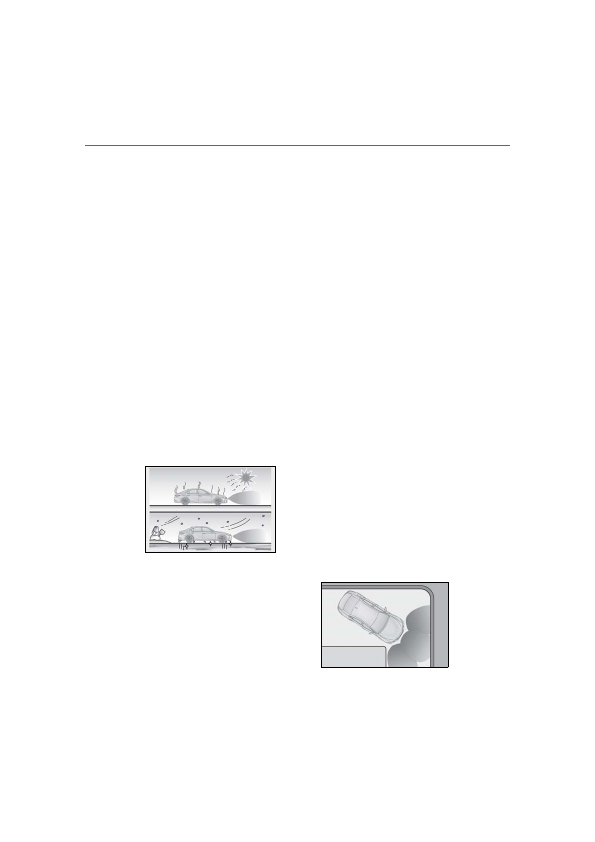
In especially cold weather, if a sensor is
frozen the sensor display may be dis-
played abnormally, or objects, such as a
wall, may not be detected.
●
When a sensor or the area around a sen-
sor is extremely hot or cold.
●
On an extremely bumpy road, on an
incline, on gravel, or on grass.
●
When vehicle horns, vehicle detectors,
motorcycle engines, air brakes of large
vehicles, the clearance sonar of other
vehicles or other devices which produce
ultrasonic waves are near the vehicle
●
A sensor is coated with a sheet of spray
or heavy rain.
●
If objects draw too close to the sensor.
●
When a pedestrian is wearing clothing
that does not reflect ultrasonic waves (ex.
skirts with gathers or frills).
●
When objects that are not perpendicular
to the ground, not perpendicular to the
vehicle traveling direction, uneven, or
waving are in the detection range.
●
Strong wind is blowing
●
When driving in inclement weather such
as fog, snow or a sandstorm
●
When an object that cannot be detected
is between the vehicle and a detected
object
●
If an object such as a vehicle, motorcycle,
bicycle or pedestrian cuts in front of the
vehicle or runs out from the side of the
vehicle
●
If the orientation of a sensor has been
changed due to a collision or other
impact
●
When equipment that may obstruct a
sensor is installed, such as a towing eye-
let, bumper protector (an additional trim
strip, etc.), bicycle carrier, or snow plow
●
If the front of the vehicle is raised or low-
ered due to the carried load
●
If the vehicle cannot be driven in a stable
manner, such as when the vehicle has
been in an accident or is malfunctioning
●
When a tire chains, compact spare tire or
an emergency tire puncture repair kit is
used
■
Situations in which the system may
operate even if there is no possibility of a
collision
In some situations, such as the following, the
system may operate even though there is no
possibility of a collision.
●
When driving on a narrow road
●
When driving toward a banner, flag,
low-hanging branch or boom barrier
Detailed Information for 2022 Lexus iS300 Owners Manual
Lists of information found in 2022 Lexus iS300 Owners Manual - Page 206
- 5. Using the driving support systems ● Cotton, snow and other materials that absorb sound waves ● Sharply-angled objects ● Low objects ● Tall objects with upper sections project- ing outwards in the direction of your vehi- cle People may not be detected if they are wearing certain types of clothing.
Related Documents for 2022 Lexus iS300 Owners Manual
 All trademarks are property of their respective owners. Tightrope
Interactive
All trademarks are property of their respective owners. Tightrope
Interactive