
Press - Page 207
2022 Lexus iS300 Owners Manual
Table of Contents
207
4-5. Using the driving support systems
4
Driving
(such as those used at railroad crossings,
toll gates and parking lots)
●
When there is a rut or hole in the surface
of the road
●
When driving on a metal cover (grating),
such as those used for drainage ditches
●
When driving up or down a steep slope
●
If a sensor is hit by a large amount of
water, such as when driving on a flooded
road
●
There is dirt, snow, water drops or ice on
a sensor. (Cleaning the sensors will
resolve this problem.)
●
A sensor is coated with a sheet of spray
or heavy rain
●
When driving in inclement weather such
as fog, snow or a sandstorm
●
When strong winds are blowing
●
When vehicle horns, vehicle detectors,
motorcycle engines, air brakes of large
vehicles, the clearance sonar of other
vehicles or other devices which produce
ultrasonic waves are near the vehicle
●
If the front of the vehicle is raised or low-
ered due to the carried load
●
If the orientation of a sensor has been
changed due to a collision or other
impact
●
The vehicle is approaching a tall or
curved curb
●
Driving close to columns (H-shaped steel
beams, etc.) in multi-story parking
garages, construction sites, etc.
●
If the vehicle cannot be driven in a stable
manner, such as when the vehicle has
been in an accident or is malfunctioning
●
On an extremely bumpy road, on an
incline, on gravel, or on grass
●
When a tire chains, compact spare tire or
an emergency tire puncture repair kit is
used
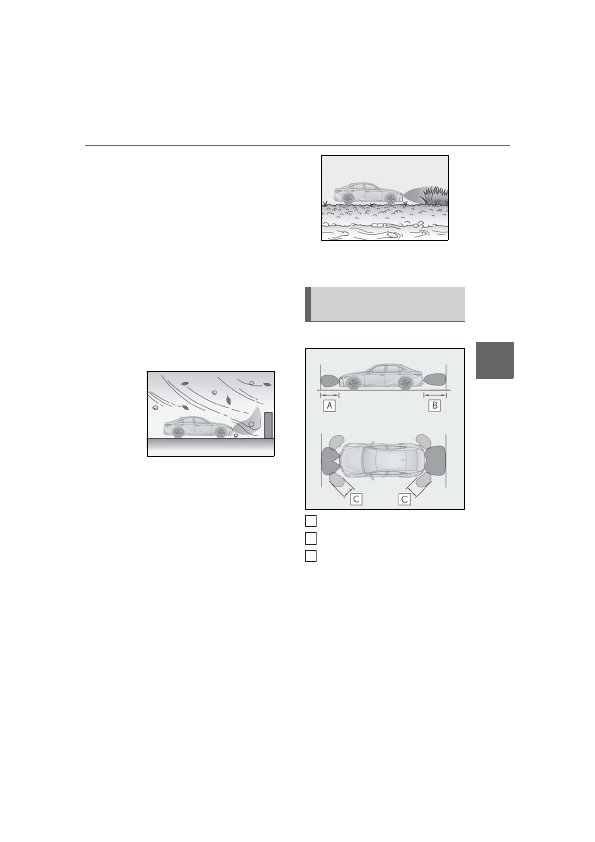
■
Detection range of the sensors
Approximately 3.3 ft. (100 cm)
Approximately 4.9 ft. (150 cm)
Approximately 2.0 ft. (60 cm)
The diagram shows the detection range of
the sensors. Note that the sensors cannot
detect objects that are extremely close to
the vehicle.
The range of the sensors may change
depending on the shape of the object, etc.
Sensor detection display, object
distance
A
B
C
Detailed Information for 2022 Lexus iS300 Owners Manual
Lists of information found in 2022 Lexus iS300 Owners Manual - Page 207
- 5. Using the driving support systems 4 Driving (such as those used at railroad crossings, toll gates and parking lots) ● When there is a rut or hole in the surface of the road ● When driving on a metal cover (grating), such as those used for drainage ditches ● When driving up or down a steep slope ● If a sensor is hit by a large amount of water, such as when driving on a flooded road ● There is dirt, snow, water drops or ice on a sensor.
- 3.3 ft.
- 4.9 ft.
- 2.0 ft.
Related Documents for 2022 Lexus iS300 Owners Manual
 All trademarks are property of their respective owners. Tightrope
Interactive
All trademarks are property of their respective owners. Tightrope
Interactive